System Requirements
Send questions to: thwang@cs.stanford.edu
Last
updated:
December
10, 1998
(See user analysis discussion for hardware requirements and environment discussion)
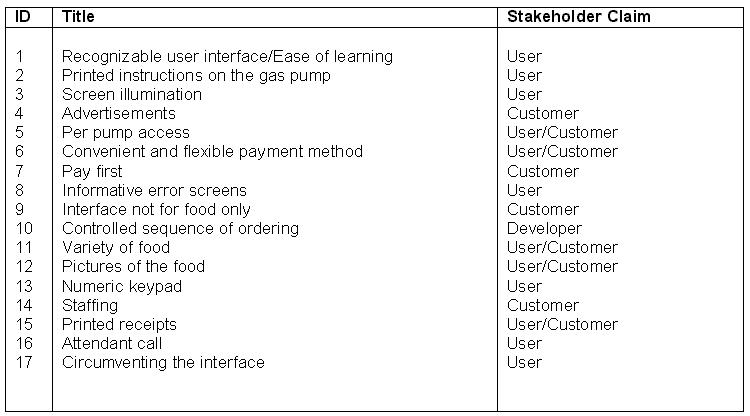
These requirements identify the interests of stakeholders in the development of the system. The requirements are summarized after they are listed below in a table by requirement ID and stakeholder.
2.1 Recognizable
user interface/Ease of learning
ID – 1
Body – The user interface
must not require an extensive learning effort and must be recognizable
to the user; it shall not be radically different from the existing gas
pump interfaces.
Rationale – The purpose
is to prevent from intimidating potential customers, particularly first
time users and users who are averse to technology.
2.2 Printed instructions
on the gas pump
ID – 2
Body – A set of static,
printed instructions shall be placed somewhere on the gas pump so that
first time or confused users may refer to them at any stage during the
gas/food ordering process.
Rationale – An electronic
set of instructions (i.e. a wizard) was considered, but ultimately voted
against because returning users would not want to repeatedly navigate through
a set of instructions, especially once they’ve gotten accustomed to this
proposed interface.
2.3 Screen illumination
ID – 3
Body – The system’s input
devices, keypad and display must be easily readable by the customers regardless
of the environment (bright day or evening).
2.4 Advertisements
ID – 4
Body – The user interface
shall adequately promote the fast food side of the business thereby generating
interest and sales.
Rationale – One of the system’s
goals is to gain a market advantage for the customer (the station operator).
2.5 Per pump access
ID – 5
Body – Each gas pump shall
have its own self-contained interface instead of at a separate kiosk like
ARCO’s PayQuick.
Rationale – A central ordering
and paying station would cause the system to be unsuccessful. There
would be contention for the pay/order station, which would become difficult
as customers negotiated their food orders. The system is designed
to gain its audience at the critical time when a customer’s gas is pumping
and the customer has nothing to do but wait.
2.6 Convenient and
flexible payment method
ID – 6
Body – The gas pump accepts
credit cards or debit/ATM cards as acceptable forms of payment.
Rationale – This requirement
allows good payment flexibility at the user’s convenience. In addition,
the system will reduce the operator’s vulnerability to employee larceny
and petty criminals by encouraging cashless transactions.
2.7 Pay first
ID – 7
Body – To protect the interests
of the gas station owners, users must pay prior to ordering gas and/or
food just like the current gas pump systems, which prompts users to pay
with cash OR use the credit/debit card reader.
Rationale – The system must
not increase the operator’s exposure to loss from non-payment by customers,
either from the actions of the customer or the actions of the bank protecting
itself from loss.
2.8 Informative
error screens
ID – 8
Body – The system must provide
an adequate explanation of reasons for declining cards. It must also
have clear explanations of any malfunctions in the payment process.
Rationale – Informative
error screens help users to recover from any errors that may occur.
2.9 Interface not
for food-only
ID – 9
Body – The user interface
shall not allow users to purchase food exclusively at a gas pump.
Users at a gas pump must minimally purchase gas and may then have the option
to buy food.
Rationale – With the limited
number of gas pumps at any one gas station, a gas pump cannot be allocated
to a user for the exclusive purpose of purchasing food when a user can
simply walk into the mart and purchase their food inside.
2.10 Controlled
sequence of ordering
ID – 10
Body – The system will first
provide an efficient procedure for purchase, delivery and payment of gasoline.
Food ordering, while necessary for a successful system, must be achieved
only after the first and most important goal is met.
Rationale – This complies
with REQ. ID 8 where users must minimally purchase gas at the gas pump.
2.11 Variety of
food
ID – 11
Body – The menu of food
offered to the users shall limit the selections to a manageable number
of items that can be easily displayed at the pump
Rationale – The purpose
of having a food-ordering interface at the pump is to encourage customers
to place orders. Large the number of items would make the ordering
process unwieldy.
2.12 Pictures of
the food
ID – 12
Body – Food menu items shall
include some pictorial representations of the food items.
Rationale – Allows the interface
to be more graphically enticing.
2.13 Numeric keypad
ID – 13
Body – The user interface
shall the touch screen for numeric input.
Rationale – This frees the
top of the face for other items required and simplifies the interface.
2.14 Staffing
ID – 14
Body – The system must not
require more staffing to operate. Sales and food service employees
must not be required to perform extraordinary tasks to maintain the system.
The system must enhance the employee’s efficiency.
2.15 Printed receipts
ID – 15
Body – The system will provide
printed receipts as written evidence of the transaction. In addition,
when a user places a food order, the user’s food order number shall be
printed at the bottom of the receipt. Also, the system output (receipts)
must be clear and useable by the user and the sales clerks.
Rationale – This will provide
service for the customers wishing to track their purchases of gasoline
as well as verification of a food order for the food service operators.
2.16 Attendant call
ID – 16
Body – The system shall
provide a call button for attendant help.
Rationale – Offers the user
comfort knowing that they may be able to receive human assistance at any
time during their visit to the gas station.
2.17 Circumventing
the interface
ID – 17
Body – The system shall
not prevent any user from purchasing gas in the traditional manner: paying
inside the mart and pumping fuel following activation by the attendant
inside.