 |
 |
 |
 |
[About Patrick][BRINQ - Innovation at Play][Articles][Photos][Clan Donohue]
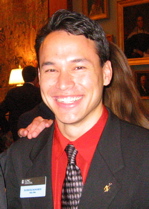 Patrick Donohue is a serial entrepreneur and a graduate of the Univeristy of North Carolina's Kenan-Flagler Business School, where he focused in Sustainable Enterprise and Entrepreneurship, graduated with honors, and served as President of UNC's MBA Student Association. Patrick is a Thomas M. Belk Premier fellow, a Kauffman Social Entrepreneurship Fellow, Kenan-Flagler's Management Development Fellow, and winner of the 2004 Kenan-Flagler Integrity Award, in part for his design and launch of a new executive leadership program for student leaders.
Patrick's work on business models to dance with poverty has been critically well received at a number of BoP conferences and seminars, including a keynote presentation to the Base of the Pyramid Lab in 2003 on business models to cultivate and capture innovation and an award winning presentation in 2004 on his team's recommendations to the Grameen Foundation's and MTN's villagePhone venture in Uganda. Patrick's current venture, BRINQ, promotes the innovation and design capabilities of poorer communities in Latin America. Additionally, Patrick is involved in the development of the Base of the Pyramid Protocol, a best-practices methodology to discover innovation and business opportunities among the world's so-called "poor". In 2005, Patrick participated in the pilot test of Protocol in Kenya, living, working, and facilitating new partnerships in Kibera, one of the world's largest slums.
Patrick has managed and developed innovative technology programs for Rockwell International, Apple Computer, and NASA, as well as consulting for a number of small businesses and entrepreneurs. At Rockwell, Patrick led a team which was awarded the 1999 Rockwell International Chairman's Team of the Year Award, and his work for NASA was nominated in 2002 for a Turning Goals into Reality Award. Patrick has a B.S. in Computer Science from Stanford University and is the proud member of a large, wacky, world-ranging Vietnamese-Irish family that is growing larger and more colorful every year. He is also the proud owner of a stuffed dog named "Ralph" who has been guarding his dreams for almost thirty years. Patrick has never forgotten the tie between toys and dreams.
BRINQ is a venture based on a single powerful belief: The world's 4+ billion poor represent a huge untapped source of innovation! Among these billions are geniuses, innovators and entrepreneurs waiting to be discovered, Einstein's, Edison's, and Ford's. Read more: |

Recent Articles from the BRINQ Workshop
Patrick's travels have taken him around the world to live and work in low income communities in Africa and Latin America. In addition to writing strategy articles and on the ground reports for the BRINQ Workshop, Patrick is also a featured writer for the World Resources Institute's NextBillion.net. Be sure to check out "Do the Poor Dream Brighter Sheep?" and "Rain Dance" too!
Side Effects - A Day in the Community
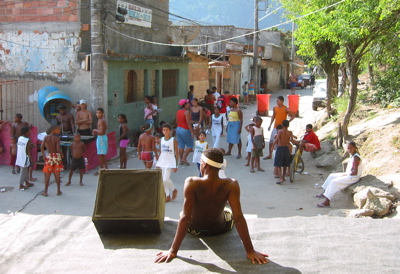
“I’d love to hear your impressions,” Theresa said to me as we boarded the bus outside of Rocinha, “about what you think of the communities here vs. where you lived in Kenya.” Here was Rio de Janiero, Brazil and in Kenya was Kibera, a million-person shantytown in Nairobi, where I had just spent the previous three months living and working. Theresa and I were catching a bus to the outskirts of Rio for a visit with local community leaders and to spend a “Day in the Community” a regular event that brings together children and neighbors from six of Rio’s favelas, Brazil’s illegal communities. Theresa and I found a seat as the bus lurched forward and I sat there wondering about her request. What preconceptions had living in an African slum given me about a South American one?
[Read the rest of ther article]
Learning to Swim - Back in Brazil

I’ve been very happy with how far my Portuguese has come, especially after having been gone from Brazil for so long, yet my ability to communicate here is like being able to swim in a gentle sea, quando as coisas estão tranqüilas, tudo bom! (When things are calm, all is good!) But while sitting in on CatComm’s open forum, a meeting for feedback from community partners and constituents, I experienced a very different world of linguistic aquatics… visualize the crashing waves at Ipanema, Brazil’s most famous of beaches, where the people are beautiful but the weak stay out of the water.
Last night, a dozen of us met inside the Casa do Gestor Catalisador, CatComm´s home and technology hub in Rio, located on the edge of the downtown, in a historic district by the bay and the center of the old slave trade. Around us on the Casa walls, on mounted wood or printed t-shirts, hung windows into the world of the favelas, the works of Brazilian photographer Maurício Hora, a man with an incredible capacity to capture the spirit of place on film. Maurício sat to my left, Theresa to my right, the rest were spread out in a circle around the room, community leaders and artists, passionate Brazilians all; not quite what my beach and bar Portuguese had prepared me for.
[Read the rest of ther article]
Base of the Samosa - What’s in a name?
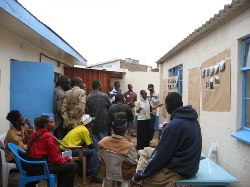
There’s nothing like a room full of blank stares to tell you that you have just used the wrong word, nobody there knows what you’re talking about and you need to adapt, but what do you do when that word is at the heart of what you do? When that glazed-eye-inducing offender is printed all over your business cards?
Erik, Kabi, Edwin and I are in a meeting hall in Kibera, a shanty town in Nairobi, Kenya which, with an estimated one million people, is one of Africa’s, if not the world’s, largest slums. We’re running the second of four community engagement workshops in which we are preparing local community groups, entrepreneurs and social enterprises, on how to best approach and prepare for a partnership with multinational companies; in this case, how to partner with our main corporate sponsor, SC Johnson. This is what we do, we bring people from diverse backgrounds and with diverse resources together, “a creative collision of world views", to create new market opportunities for multinationals and locally grown businesses for poor communities via a process of “mutual value creation". Buzz phrase laden work, yes, but it’s actually all been going quite well so far, except that now our community partners are stuck on our name. Behind us, on a brown flip chart taped to the wall, is drawn a large three sided figure, a triangle really, with the words “Base of the Pyramid” written on top, or BoP for short. That’s us.
[Read the rest of ther article]

In less than a week we hit the ground in Kenya, to begin the pilot test for the Base of the Pyramid (BoP) Protocol, a multinational, NGO, and university sponsored effort to find innovation and business opportunities among the world’s poor. Sure, we’ll spend time at corporate offices, with NGOs and government officials, but most of the time we’ll be visiting and living with people who don’t have easy access to running water or electricity, probably not phones or computers either. So, being an MBA, I fixated right away on the most important question.
Should we bring business cards?
[Read the rest of ther article]
Links to Patrick's Photo Galleries
 BoP Protocol Idea Generation Workshop25 photos |
|
 BoP Protocol in Kenya, Set 634 photos |
|
 BoP Protocol Pilot in Kenya, Set 331 photos |
|
 BoP Protocol Pilot in Kenya, Set 217 photos |


Patrick gains a lot of inspiration from his talented and diverse family, which includes dancers, actors, writers, teachers, designers and more. Below are a number of websites and businesses of the Clan.
 |
MAI DONOHUE "They write Hollywood scripts about women like Mai Donohue and no one ever believes such stories could be true. But they are." |
MAURA DONOHUE "Kick ass dance and dancing" - The Dance Insider "Donohue's work delivers a sociopolitical wallop" - Village Voice "Cross-cultural, uniquely New York stories about roots…" -Dance Magazine "Like observing unfamiliar rituals in a distant country" - NYTimes |
 |
 |
MAURA DONOHUE "We must join and extend our hands and hearts to encourage fluid creativity and strong friendships the same way the flowing Mekong nurtures our lives." - Narumol Thammapruksa, Artistic Director, Artist Residency Projects |
PERRY YUNG "He is fast becoming one of the few Americans who make and repair shakuhachi" - Ronnie Nyogetsu Seldin, Grandmaster See also the Slant Performance Group "Three extremely talented young Asian American men." - NYTimes |
 |
 |
MAEVE DONOHUE & DAVE GONVILLE Nami Studios is a small, new-media, graphic design and illustration studio, created to offer intelligent, innovative, and individualized solutions to businesses looking to move ahead in today’s rapidly evolving marketing environment. |
MAEVE DONOHUE In 2003, Maeve Donohue and David Gonville started a design studio in part of the space and lovingly refinished the rest of the floors for yoga, taking care to preserve their original character. The beautiful floors, 20-foot high ceilings, generous south facing windows and relatively isolated location provide a tranquil space for a restorative and rejuvenating yoga experience. |
 |
 |
BERNARD G. DONOHUE, III "Last night I attended the Burbank Jaycees A&I. . . if you've never heard him speak before, let me tell you... Bernard Donohue can give a great speech. It was a really nice evening. But, aside from all the awards, recognition, "hellos", "good-byes", and, well...Bernard, we were privileged to . . ." - Craig Valine, President, Junior Chamber of Commerce, State of California |
AILEEN DONOHUE BROWN In 2003 Aileen and her team were awarded Emmy's for NBC's coverage of the XIX Winter Olypmic Games in Salt Lake City, Utah. Aileen has since left NBC to follow her true passion, teaching early childhood education. |
 |
 |
ROB BROWN Capstone Wealth Management is a global financial firm that provides sophisticated wealth management services to institutions and high net worth individuals. We help executives and business owners develop tax-efficient strategies for building and growing wealth and protecting capital through a comprehensive and customized planning process. |
 Patrick's old Stanford CS page can be found here.
[About Patrick][BRINQ - Innovation at Play][Articles][Photos][Clan Donohue]