Note: I have moved to MIT
Last updated: 9/96

Erik Rauch
I'm currently a graduate student in the Computer Science Department at Stanford.
I graduated in May 1996 from Yale, majoring in Computer Science
and Math.
You can see my other home page here, with some fun and interesting links.
My vita in hypertext or postscript.
Some Research Interests
Nonlinear dynamics and fractals
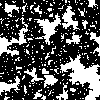
At Yale, I did my undergraduate thesis work with Benoit Mandelbrot, on the fractal properties of the
Ising model at the critical state. I'm also investigating lacunarity,
a measure of the "texture" of a fractal.
I continued last summer as a visitor at IBM T.J. Watson Research Center.
Multi-agent systems
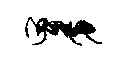
I'm intrigued by collective intelligence and the possibilities of achieving
intelligent behavior in a distributed way. A great metaphor for this, or inspiration if you
like, is the social insects. An ant colony gracefully
shifts resources around, and responds to its environment in a coordinated
way, without any sort of central organization. There is no one ant that
gives the orders, and each one can sense only its immediate environment;
but a swarm of them exhibits global cooperative behavior,
and the species has been incredibly successful. Maybe this
very lack of central command is a source of strength, and in some sense
the functionality of the whole is more than the sum of its parts.
At the Center for Nonlinear Studies at Los
Alamos and the Santa Fe Institute, I worked on a project started by physicist Mark Millonas and Dante Chialvo to better understand this kind
of mass action by creating a model containing what we believe to be the minimum components necessary for swarm dynamics and analyzing it.
Our conclusions are about the functionality of the swarm. In particular,
it has the ability not only to form stable patterns of traffic,
but to shift them in response to a small outside stimulus. We found that
the swarm has this "information-magnifying" ability when its behavior
is just below a second-order phase transition separating ordered from
disordered behavior.
If you're interested, I am the first author of a paper in Physics Letters A that you can read in
hypertext format or postscript (with figures).
(If you want to hear more, and happen to be going to the
March conference of the American Physical Society, I'll be giving a talk on it.)
Evolutionary computation
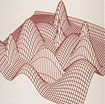 I've also worked on genetic
algorithms. In 1993 I wrote MPGA, a parallel GA in C++ and Linda, as part of a computational biology project. The GA
is being used to optimize 60 floating-point variables in simulating a mathematical model of the development of the fruit-fly embryo.
I've also worked on genetic
algorithms. In 1993 I wrote MPGA, a parallel GA in C++ and Linda, as part of a computational biology project. The GA
is being used to optimize 60 floating-point variables in simulating a mathematical model of the development of the fruit-fly embryo.
Related links
Second International Conference on Multiagent Systems
ICMAS96 Workshop on Animal Societies
Physics of Computation '96
Adaptation, Co-evolution and Learning in Multiagent Systems
From Animals to Animats:
The Fourth International Conference on Simulation of Adaptive Behavior
Dynamical Systems and Learning at Brown
Information Mechanics Group (Physics of Computation) at MIT
American Physical Society March Meeting
Fifth Annual Conference on Evolutionary Programming
Xerox Dynamics of Computation group
Neural Nets and adaptive comp. at LANL
ALife Bibliography
Computational Ecology at Yale
Local resources
![[Stanford]](http://www-cs.stanford.edu/gifs/stanford.seal56.gif)
![[CS Dept.]](http://www-cs.stanford.edu/gifs/logo.csd.gif)
![[Students]](http://www-cs.stanford.edu/gifs/arrow.marble56.up2.gif)