CS 348b Final Project Proposal
Rene Patnode, Evan Parker
Ice Sculpture
For our project we plan on simulating various properties of ice. This includes,
of course, basic things like reflection, but also effects which are caused by
the particular physical properties of ice. We will do this in the form of an
"ice sculpture."
We believe that this is an interesting project because, on one hand, the physical
properties of ice can be simulated by cutting edge graphics technique, and,
on the other, ice can be used to great artistic effect.
We see our key technical challenges as follows:
- Obtaining model(s) for the sculpture (we'll probably use something like
the bunny, buddha, or dragon)
- Simulate basic reflective and refractive properties (including Fresnel effects)
- Simulate effect of air bubbles within ice on the propagation of light through the ice
- Simulate chiseled surface
Our approach:
- Research physical properties of ice (e.g. index of refraction, dispersive properties, scattering properties)
- Implement basic reflection and refraction model.
- Accurately model the concentration of air bubbles throughout a block of
ice.
- Implement a subsurface scattering (model that captures the scattering of
light due to large concentrations of air bubbles.
- Implement wave-length dependent dispersion effects. We will use this to
model the bluishness of ice caused by air bubbles.
- Model the hewn surface of the ice using bump mapping or displacement mapping.
To split up the work we will probably have one person focus on obtaining both
a geometric model of the sculpture to render and a physical model of ice with
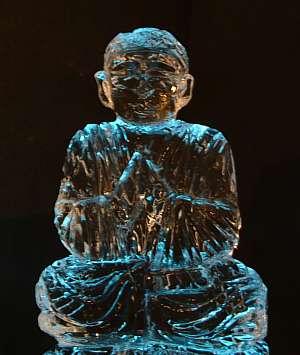
the goal of rendering an initial sculpture made from perfectly clear ice (like
the buddha below). The other person will then focus on modeling the distribution
of bubbles in the ice and developing a subsurface scattering model with the
goal of rendering an sculpture made from uniformly impure ice. We will then
attempt to combine these models with the goal of rendering a sculpture where
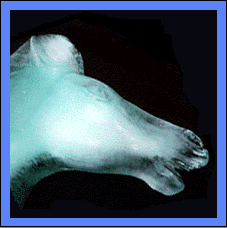
the ice is partially clear, partially impure (like the sculpture of the horse
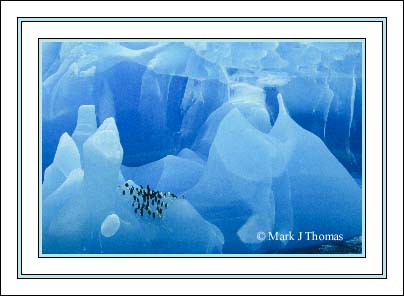
below). Finally we will work on the dispersion of light within the ice (to get
the deep blue tint often seen in glacier ice) and the bump/displacement mapping
of the surface.
Below are some examples of real ice sculptures.
- A buddha made from clear ice. The effect of the Fresnel effect can be seen
along the edges of the sculpture, where most of the light is reflected rather
than refracted. This is probably fairly close to what our first attempt will
look like.
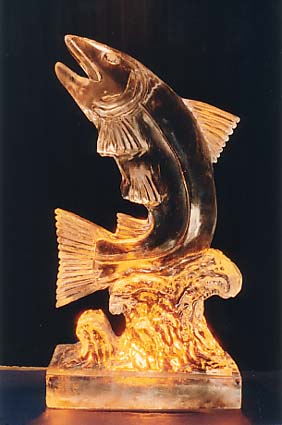
- A fish jumping out of water, also made from clear ice. The way the yellow
light propagates throughout the sculpture is particularly intriguing.
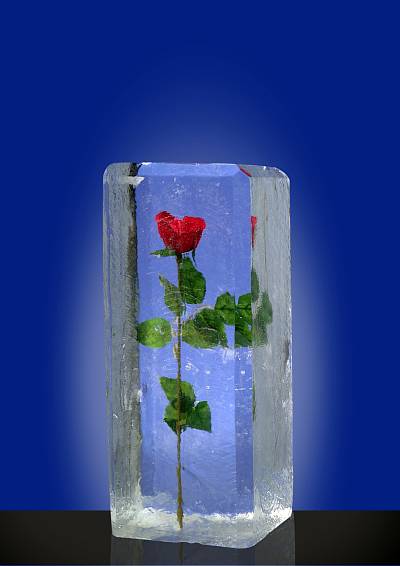
- A rose inside a block of clear ice. Note the reflection and refraction,
as well as the chisled nature of the surface of the ice. The effect is just
beautiful. If we could render something like this I would be happy.
- The head of a horse made from partially impure ice. Oxygen bubbles trapped
within the center of the ice cause the light to scatter and disperse as it
travels through the sculpture, giving that part of the sculpture a soft, blue
feel to it. Notice that near the surface of the sculpture the ice is more
pure, hence there is less scattering.
- A picture of some penguins on a glacier. This picture highlights the dispersive
effects of air bubbles trapped in ice.